
The 5-Step Guide to Measuring Cultural Alignment: How Top Companies Ensure They’re Living Their Values

The 5-Step Guide to Measuring Cultural Alignment: How Top Companies Ensure They’re Living Their Values

When everyone is moving in the same direction with shared values, organizations become better workplaces and better businesses.

Two companies could have identical business models, similar talent, and the same market opportunities, but one thrives while the other struggles to keep good people and hit its targets.

The difference often comes down to something you can’t see on an organizational chart: cultural alignment. When everyone in your organization understands and lives your company’s values, trust is higher, decisions get made faster, teams collaborate better, and people stick around because they believe in what they’re building together.

It’s more than just a feel-good story. Companies with high-trust cultures are more profitable and have higher stock market returns. Research from FTSE Russell shows that companies on the Fortune 100 Best Companies to Work For® Llist outperform the market by a factor of 3.68.

The challenge is that cultural alignment doesn’t happen by accident, and you can’t mandate it through company-wide emails or motivational posters. It requires deliberately measuring where you stand, identifying gaps, and systematically closing them.

Understanding cultural alignment: The foundation of a thriving workplace

Picture a sports team where no one agrees on how to win. Players are ball-hogging, the defense isn’t playing cohesively, and nobody’s communicating. That’s a workplace without cultural alignment.

Now, imagine the same team where everyone is clear on the game plan, and everyone trusts their teammates. They’re passing the ball, working together to block the other team, and reading each other’s moves. That’s cultural alignment in action.

Cultural alignment means everyone in your organization is committed to the same goals and shares the same values — one of the key elements of great company culture.

It’s different from employee engagement. You can have someone who loves their job but still operates like they’re playing for a different team. Engagement is about enthusiasm; alignment is about direction.

When a workforce is culturally aligned, employees work as a team and achieve higher results. Here’s how you can methodically measure and improve your organization’s cultural alignment. 

Step 1: Define and communicate your core values

What is your company’s purpose? What principles guide your day-to-day actions? How do your employees feel at your organization, and how do you want them to feel? These are the questions that will help as you begin defining your company’s core values.

Once you’ve identified your values, make them clear and actionable. Skip generic words like “excellence” that could apply to any company. Instead, get specific about what these values look like in practice. Rather than “we value teamwork,” try “we win together by having each other’s backs in the good times and the bad.”

You can weave your values into hiring questions, performance reviews, and team meetings to reinforce them. For example, maybe at the start of every all-hands meeting, you share stories about employees who recently embodied these values.

Step 2: Assess current cultural alignment

If your values are your organization’s north star, then tools like employee surveys, focus groups, and one-on-ones are the compass that tells you how to find it.

Ask employees questions like:

  • How well do you understand our organization’s core values, and can you describe what they mean in practice?
  • In your day-to-day role, how easy or difficult is it to live out our values?
  • How consistently do leaders and managers demonstrate our stated values in their actions and decisions?
  • When decisions are made, do they feel aligned with our values? Why or why not?
  • Do our values make you feel more connected to your team and the organization as a whole?
  • How inclusive do you feel our culture is, based on the way our values are practiced?
  • Where do you see gaps between our stated values and how we actually operate?
  • What is one change you would suggest to better align our daily practices with our values?

By soliciting employee feedback, you can identify not only whether your workforce knows your values, but whether they agree with them in the first place. Employees may identify new values that resonate more deeply with the team. Or they may feel that your company values aren’t being lived by the organization at all. Great Place To Work®’s employee engagement survey tool can help you identify those deeper values and access detailed data on the employee experience.

Step 3: Identify gaps and opportunities

Once you have the data, you can analyze the results to identify any misalignments. Pay attention to what leadership thinks is happening versus what employees experience on a daily basis. If a specific demographic of employees mentions that “leadership says one thing but does another,” you’ve found a crack in your foundation.

Pay special attention to disconnects between departments or levels. Maybe your sales team describes company culture completely differently from your engineering team, or managers and frontline employees feel like they’re working for different organizations.

If there are multiple misalignments, you may not be able to correct them all right away. You could prioritize the most commonly cited issue or the one that’s easiest to fix first. Ideally, your strategy should be a mix of both — what’s most critical and most reasonable to address.

Most importantly, share the results. Don’t quietly try to fix cultural problems behind closed doors. While it might be uncomfortable to admit that your culture isn’t perfect, transparency builds trust.

Here are some tips for how to share employee survey results:

  • Have the CEO thank employees for participating and share organization-wide results
  • Ask managers to discuss the feedback with their teams and create department-level action plans
  • Provide clear next steps on how and when issues will be addressed
  • Consider a mix of communications, including town halls, videos, newsletters, and emails

Step 4: Develop and implement alignment strategies

It’s not enough to have the culture data — you now need to act on it.

If your company culture is misaligned, you’ll want to work on resetting it. Even if your company culture is quite strong, look for ways to make it even better; otherwise, complacency could eat away at it.

“Remember, you build trust by not only gathering feedback, but by telling your people what you’ll do, when you’ll do it, and how it’s going,” says Seth Willis, business advisor with Great Place To Work®. 

The most successful organizations weave their values into every touchpoint of the employee experience, from the questions they ask in job interviews to how they celebrate wins and handle failures. For example:

  • Leadership training and development: Being a great leader is more than just running the organization. It’s also knowing how to connect with your people, which fuels a positive company culture. For example, at Cisco, new and existing leaders are thoroughly trained in how to communicate with their teams and bring out the best in them. 
  • Onboarding and continuous learning programs: Trust starts with hiring and onboarding by ensuring people feel like a valued members of the team even before they walk through the door. Then, continue to reaffirm their value through employee training and development.
  • Recognition and reward systems aligned with core values: Celebrating employees who exemplify your culture demonstrates its importance. At Capital One, “Spot Awards” recognize associates who live the company’s values and go above and beyond in the work they do. Recipients receive points that can be redeemed for gifts, gift cards, or cash paid directly through payroll.

And if there are things that need improvement but can’t be fixed right now, be honest.

“If there are things you can’t implement, explain why, both company-wide and on the team level,” says Seth. “Create space for questions in the way that works best for your culture. That could be anonymously, one-to-one, or town-hall style. Closing the loop indicates that surveys are a real way employees can be heard.” 

Step 5: Continuously monitor and refine

Your culture will naturally evolve as your company grows, faces new challenges, and brings in fresh perspectives. To maintain alignment, track meaningful indicators like retention rates, promotion rates, and how long it takes for new hires to feel like part of the team.

Note the gaps identified in your employee survey and then compare those results year over year or after you’ve implemented changes from your action plan.

And Continue to solicit honest feedback, not just through annual surveys, but also through regular pulse checks, exit interviews, and informal conversations. With a steady feedback loop, you can spot patterns and adjust course as you go, rather than waiting for problems to compound.

The role of leadership in fostering cultural alignment

Cultural alignment starts at the top. When employees see leadership modelling desired behaviors and values, it reinforces that these aren’t just platitudes on a poster — they’re truly at the heart of your organization.

Here are some examples of how great leaders inspire employees:

  • Offer leadership training that focuses on how leaders impact people. For example, Mastercard hosts communication workshops focused on building executive presence and authentic connection. Leaders learn how to present powerfully with stories, drive purposeful conversations, and handle tough questions.
  • Use storytelling and executive reinforcement. At American Express, leaders frequently share examples of how they’ve pushed back earlier in their careers when a proposed idea or directive didn’t feel right — demonstrating how important it is to speak up.
  • Create recognition programs for upholding values. Wegmans runs peer- and manager-nominated awards for employees who demonstrate their values, with a “Superstar Award” for living multiple values. Superstars receive a personalized thank-you letter from their senior vice president and are celebrated on the intranet and customer social spaces.  

Overcoming common challenges in cultural alignment

If you encounter resistance to your company culture, dig deeper to understand the source. 

Perhaps employees have seen too many culture initiatives come and go or observed contradictory behavior by leadership — such as a gap between what you say you value and what you actually reward. 

For example, you might preach collaboration while your bonus structure rewards individual achievement, or claim to value work-life balance while promoting the people who answer emails at midnight.

Take an honest inventory of your policies, promotions, and recognition systems. If they don’t align with your stated values, then fix the systems —, not the messaging —, and address the issue honestly. Start small, prove you mean it through actions, and be patient while trust rebuilds.

The impact of strong cultural alignment: Success stories from top companies

Companies with strong cultural alignment don’t just provide a better employee experience — they also gain competitive advantages like lower turnover and higher customer loyalty.

Here’s how two Best Workplaces™ addressed their issues of cultural misalignment:

Matching actions to your mission: Wellstar’s safety transformation

While the health care industry is about caring for others, the irony is that many health care employees experience low well-being, burnout from long hours, and hazardous conditions. This was an issue Wellstar Health System noticed, with employees concerned about their physical safety.

Data from their Trust Index™ Survey indicated a misalignment between what Wellstar offers to its clients and how its employees were feeling. In response, the leadership team initiated strategic investments in safety, demonstrating to employees that their concerns had been heard.

By increasing leadership accountability, Wellstar saw lower employee turnover and higher patient satisfaction.

Closing the gap between values and reality: Brains’ community impact focus

At creative agency Brains, 92% of employees say it’s a great place to work. , but despite this, the company continually looks for areas where it can improve the culture. For example, in 2023, it realized that only 72% of employees felt good about the way Brains gave back to the community — one of the lowest scores on its Trust Index Ssurvey.

Using insights from the survey, Brains was able to better focus its efforts and explore different ways that employees like to give back, ensuring the company’s actions better aligned with the team’s values.

The result: a clearer sense of purpose and a 13-point increase in company pride.

Fostering a values-driven culture through alignment

Creating a values-driven culture isn’t about perfect mission statements — it’s about consistent alignment between what you say and what you do. Great workplaces regularly measure their company culture to identify and close those gaps. As a result, they see a better employee experience and higher business performance.Great Place To Work offers comprehensive tools and resources to help you measure and improve your cultural alignment to gain a distinct competitive advantage.


Seth Willis

Seth Willis is a culture coach at Great Place To Work®, walking companies through their Great Place To Work employee survey results, using deep insights to help companies create a better employee experience. With his background in communications and business administration, Seth helps leaders in an array of industries identify their strengths and opportunities to create great workplaces For All™.
High-Trust Leadership Unlocks Growth at Small- and Medium-Sized Businesses

High-Trust Leadership Unlocks Growth at Small- and Medium-Sized Businesses

Developing Leaders

Companies with stronger survey scores on leadership effectiveness had much stronger revenue growth, according to analysis from Great Place To Work.

How employees feel about their leaders has an enormous impact on business performance.

At small- and medium-sized companies? The results are inescapable.

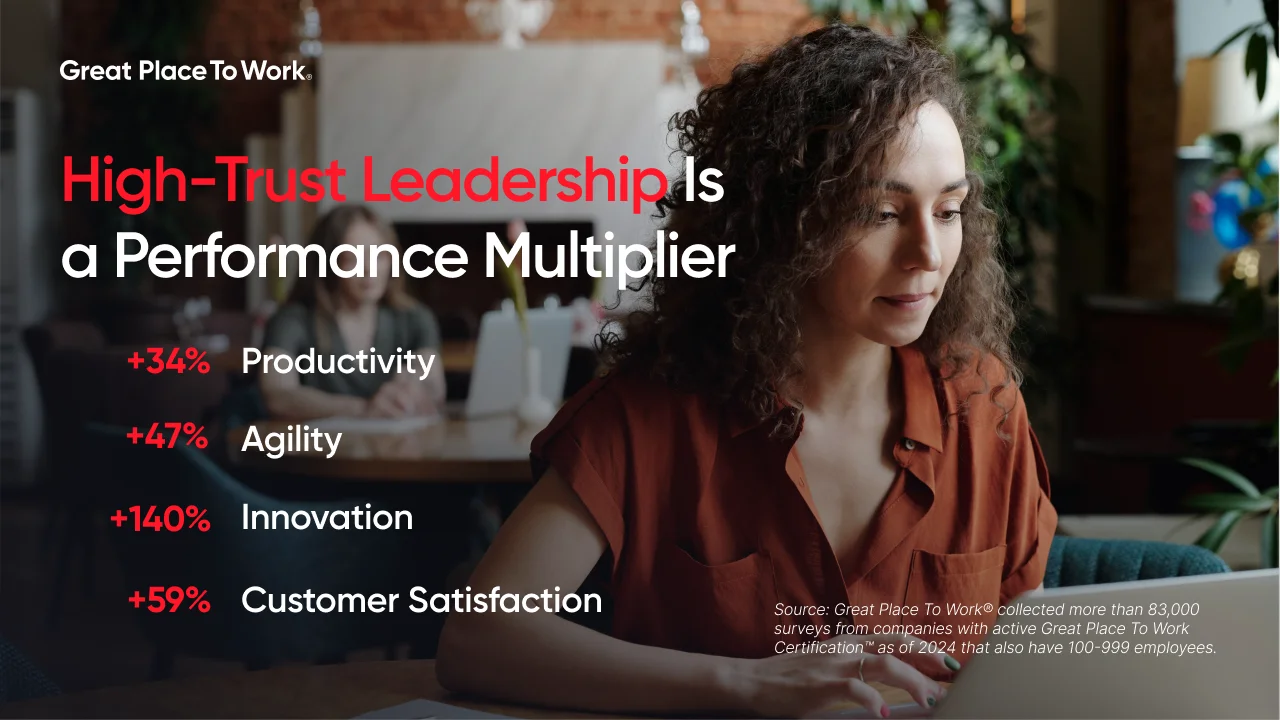
Great Place To Work® has shown that high-trust workplaces — companies like the Fortune 100 Best Companies to Work For®, where employees trust their leaders and their colleagues — dramatically outperform the stock market and on measures of revenue as part of the Great Place To Work Effect.

But does that effect hold true for smaller companies?  Yes.

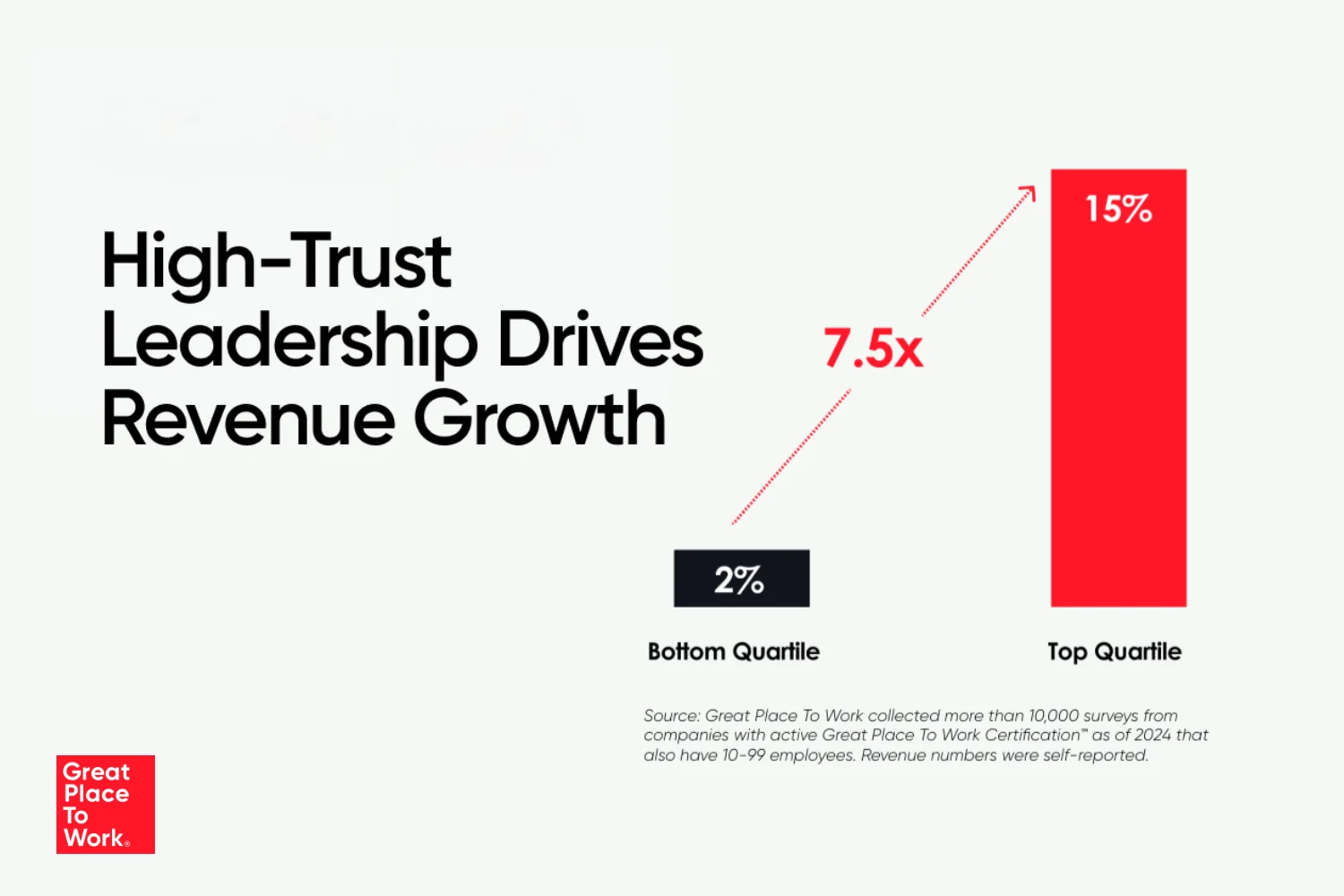
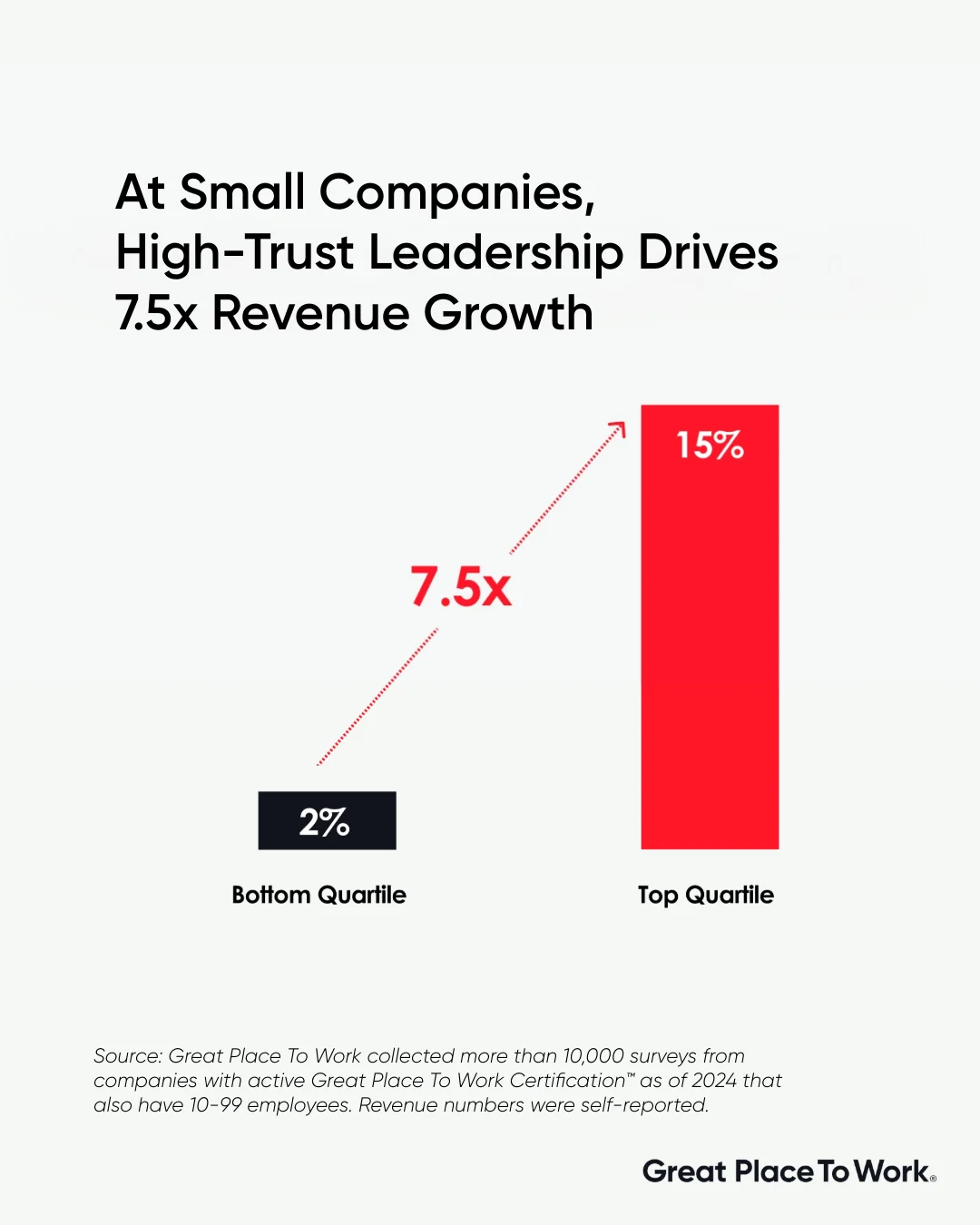
Great Place To Work measures leadership effectiveness as part of its 60-question proprietary Trust Index™ Survey. For small companies (10 to 99 employees) in the top quartile of leadership scores, revenue grows 7.5 times faster than at companies in the bottom quartile, per a Great Place To Work survey of more than 10,000 employees at more than 250 companies.

That’s the difference between double-digit growth at 15% year-over-year and flatlining growth at just 2%.

SMB Project FINAL 2 1

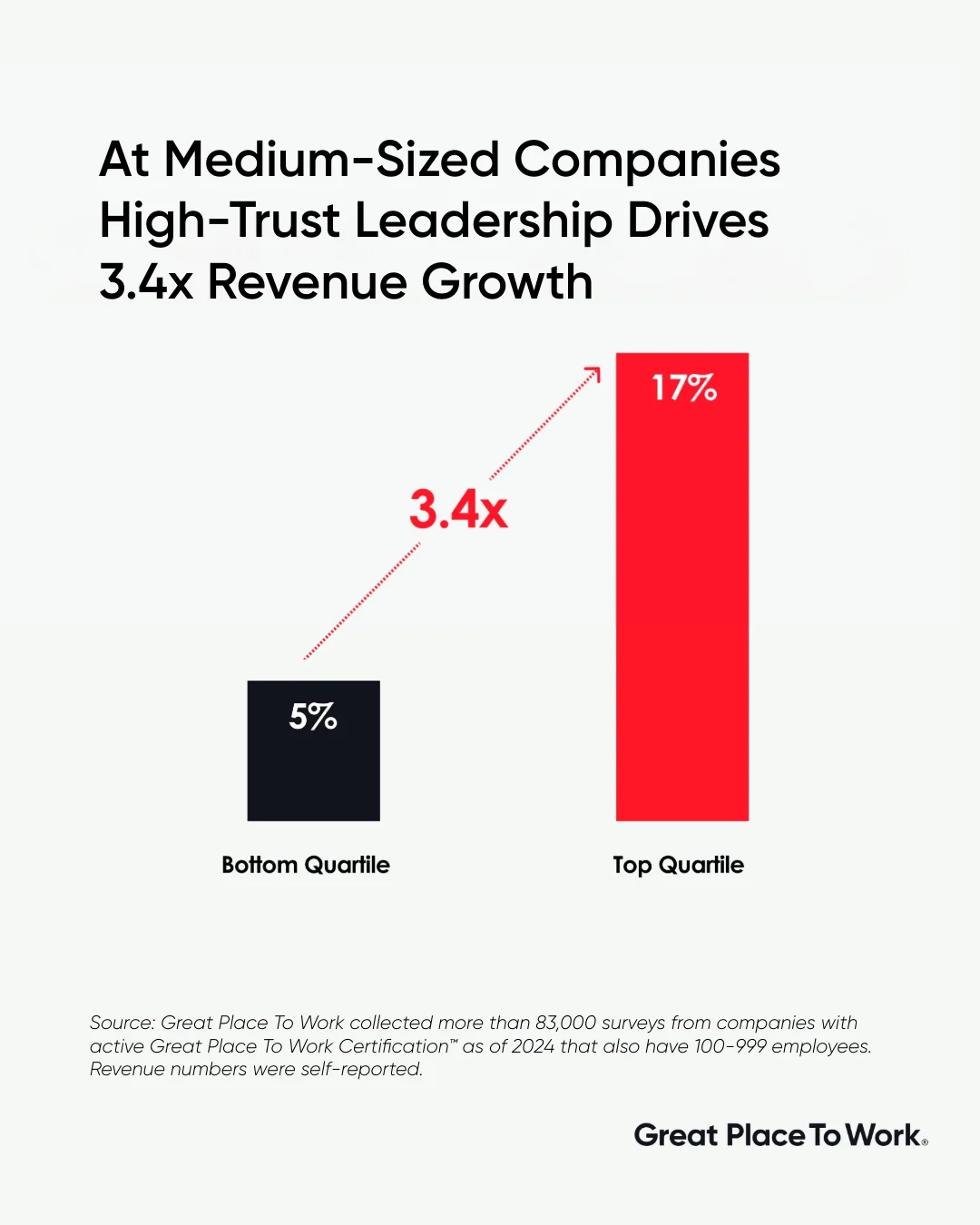
Even for slightly larger “medium-sized” companies with 100 to 999 employees, the impact of higher leadership scores correlates to 3.4 times more revenue growth, per a Great Place To Work survey of more than 83,000 employees at nearly 400 companies.

SMB Project FINAL 4 1

SMBs have different priorities

At companies with fewer than 1,000 employees, leadership makes a huge difference. Leaders can rally people to meet tight deadlines, quickly pivot from a failing strategy or launch new products to deliver the revenue that smaller businesses desperately need. In these smaller organizations, one leader has a much bigger impact than they might at a larger company.

“There are fewer buffers between top leadership and people on the front line,” explains Krittika Deshwal, principal business data analyst at Great Place To Work. “As a result, leadership scores on surveys have a stronger correlation to business performance.”

SMB Project FINAL 6

The leadership opportunity

High-performance workplace culture starts with leadership, and the trust that is built through the nine high-trust leadership behaviors.

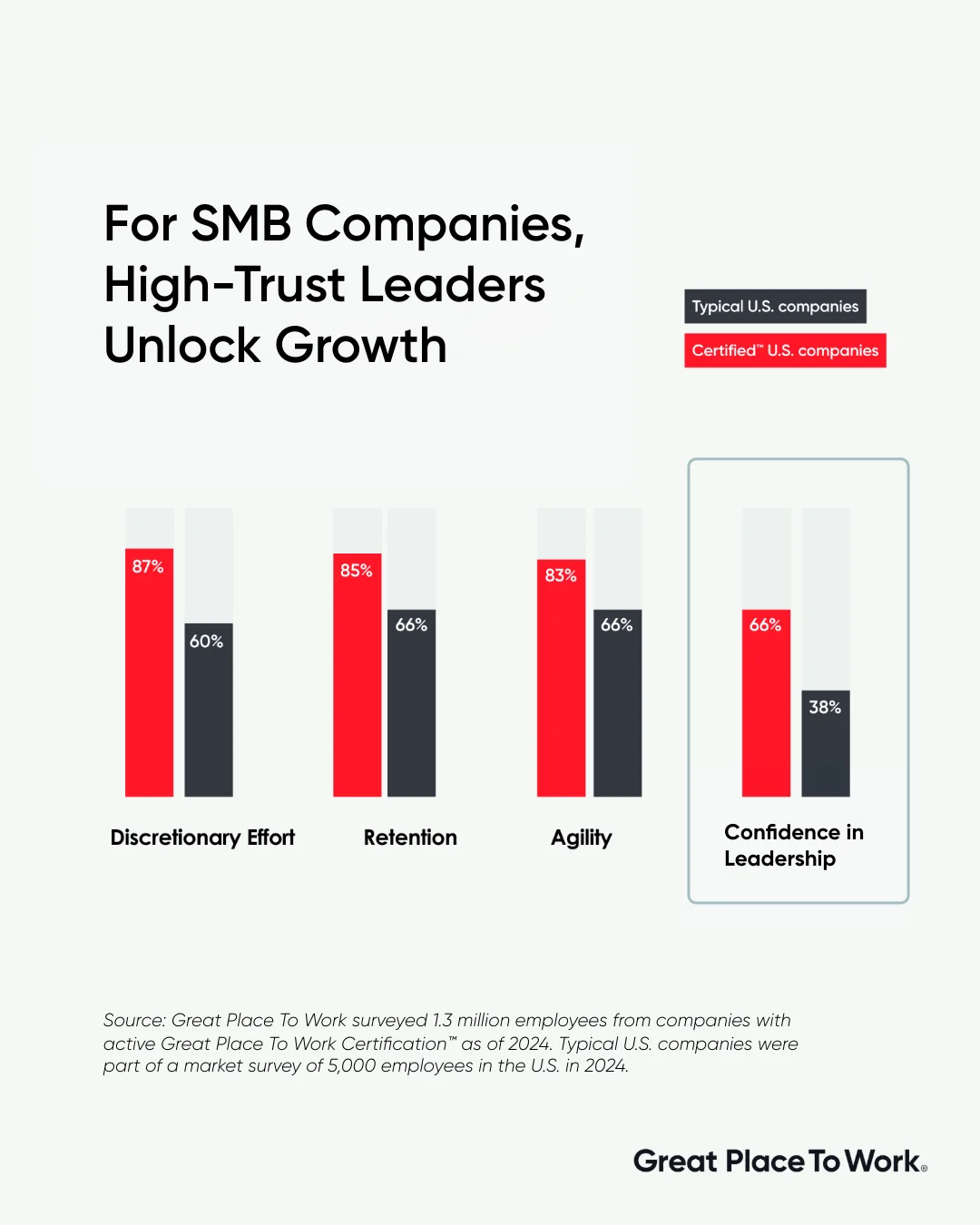
Great Place To Work Certified™ companies report higher confidence in their leaders — 66% versus 38% at typical workplaces, an increase of 74%. That leadership gap helps explain their outperformance on measures of productivity, agility, and retention.

“Because our model is interconnected, measuring confidence in leadership gives us a clear signal on performance across the organization,” explains Deshwal. “Using odds ratios, we can see how leadership drives a range of important outcomes.”

The outsized revenue growth enjoyed by the top quartile of companies is due to consistent improvement on the survey, Deshwal says.

“Companies that intentionally invest in leadership are growing their revenue much faster than their peers, which means measuring leadership effectiveness is key for survival as a small or medium business.”

High Trust Leadership Drives Performance 3

Leadership practices that drive results

What should leaders at small and medium-sized businesses do to capitalize on the value of high-trust leadership?

Start with access and connection, says Julian Lute, insights and innovation strategist at Great Place To Work.  

“Employees in small companies watch leaders closely and are constantly assessing their direct relationship with decision-makers,” he adds. “If you feel your leaders are approachable, friendly, and invested in your success, that makes an even bigger difference in those workplaces built on personal relationships.”

The value of leadership also demands investment in leadership, even for early-stage businesses. “Onboard leaders with clear expectations and give them regular space to practice leadership, not just chase goals,” Lute says.

To get everyone comfortable with accountability, Lute recommends that leaders practice going first in owning mistakes. “On smaller teams, wins naturally feel collective, but losses often get assigned to one person,” he says. “That dynamic kills trust and discourages people from taking risks.”

The risk for any leader is trying to change too many things at once. Small companies fighting for their survival might feel they don’t have the luxury to focus on only one problem at a time. However, cultural change requires consistency and repetition, both of which benefit from a clear and simple objective.

“Pick one behavior to improve right away, such as clarifying decisions, slowing down to listen, or closing communication loops,” Lute recommends. “Tell your team what you are working on and show the change in action.”


Ted Kitterman

Ted Kitterman is a content manager for Great Place To Work®. Ted has experience covering the workplace, business communications, public relations, internal communications, work culture, employee well-being, brand purpose and more. His work shines a light on the unparalleled data and insights offered by Great Place To Work’s decades of research, helping the company share its vision of a great place to work For All™.

Journey To Great Benchmarks: Measure Progress Against Your Peers

Journey To Great Benchmarks: Measure Progress Against Your Peers

Employee SurveysPost-survey

Building a great workplace starts with understanding where you stand, but only if you’re measuring against the right benchmarks.

Not every company is ready to benchmark against the best of the best. And that’s okay.

While it’s great to learn from the Fortune 100 Best Companies to Work For®, comparing yourself to these when you’re still early in your culture journey doesn’t just feel discouraging — it makes it nearly impossible to prioritize the right actions, demonstrate progress, or build momentum.

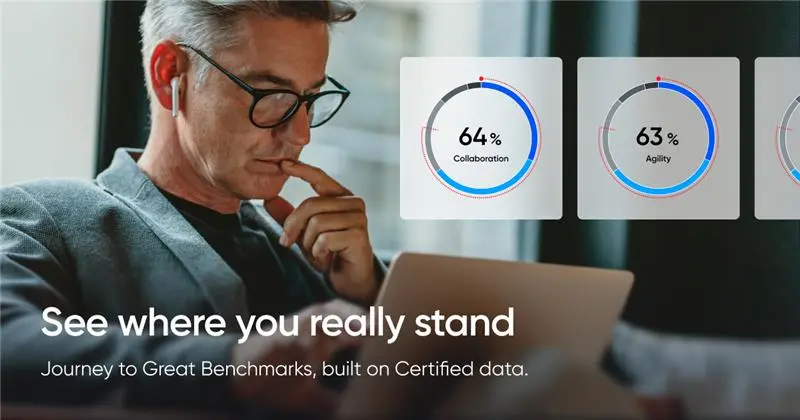
That’s why we created our Journey To Great Benchmarks: a new way to measure your workplace culture against organizations that actually look like yours.

This feature in Emprising™ gives culture leaders the clarity and confidence they need to turn data into action, celebrate meaningful wins, and keep their teams moving forward on the path to becoming a great workplace.

The problem with one-size-fits-all benchmarks

We know that organizations are looking for credible data and benchmarks that reflect their reality, from companies that share similar characteristics, such as location and employee size.

Many of our 22,000+ customers have said they see great business results using the Trust Index™ and that comparing against the 100 Best lists helps to guide their initiatives, but they also need comparison data that reflects where they are in their journeys right now.

Without this data, they face challenges like:

  • Difficulty demonstrating meaningful progress – it’s hard to show improvements to decision-makers when measurements are always against top-tier companies
  • Goals feeling irrelevant – when benchmarks feel unattainable or don’t reflect your organization’s size or region, it feeds discouragement rather than motivation
  • Missing realistic data for strategic planning – you need appropriate benchmarks to inform your strategy, prioritize focus areas, and understand what “good” looks like for your workplace
  • Losing competitive advantage – without clarity on where you’re falling behind or where you’re ahead of peers, you can’t identify your organization’s competitive edge

Our new Journey To Great Benchmarks address these challenges, so that businesses can make better decisions, driven by real data.

Benchmarks built for your journey

Journey To Great Benchmarks give you more ways to measure your workplace culture.

Instead of comparing your workplace to 100 Best list-makers, you’ll see how your organization stacks up against Great Place To Work® Certified™ peers at a similar stage in their culture journey, segmented by size and region.

All customers can opt to have Journey To Great Benchmarks added to their account. Once activated, they’ll be accessible within the Emprising platform, so you can access benchmarks alongside your survey results without switching tools. For customers with Analyze and Accelerate subscriptions, this feature can be an especially valuable add-on to your data.

Journey To Great Benchmarks make it easier to spot gaps, prioritize efforts, and build action plans based on what’s working for similar organizations. It also helps you track progress over time and tell a compelling story of growth to leadership — showing that building great culture is a journey, not a destination.

These benchmarks are refreshed annually and drawn exclusively from Certified companies, so you’re always measuring against credible, current data.

4 key benefits of Journey To Great Benchmarks

Think of Journey To Great Benchmarks as your personalized roadmap to building an even greater workplace.

Relevant comparison points

Benchmarks are segmented by company size and region, so you’re measuring progress against your relevant peers rather than outliers.

Smarter action planning

You can use Journey To Great Benchmarks to identify your workplace’s strengths and weaknesses and turn data into clear action plans that drive real business outcomes.

Clarity for leadership buy-in

Journey To Great Benchmarks give credibility and context to your efforts, helping you to demonstrate measurable progress for your executive team.

Accelerate growth

Use the Benchmarks to track incremental improvements, celebrate milestones, and reinforce your commitment to building a high-trust, high-performance workplace.

“Only Great Place To Work combines proprietary data, the credibility of Certification, and decades of trust research to offer benchmarks that are as actionable as they are aspirational.” – Sarah Lewis-Kulin, EVP global recognition and research, Great Place To Work

How to put Journey To Great Benchmarks to work

HR and people leaders can use these benchmarks to inform action planning, identify opportunity areas, and build momentum toward a high-trust culture.

Here are a few ways you can apply these benchmarks to enhance your culture initiatives:

  • Demonstrate progress to leadership: Show how your workplace culture is improving relative to comparable Certified companies and prove the value of investing in culture
  • Motivate teams: Set targets based on what similar organizations are achieving and celebrate milestones that reflect your current stage rather than aspirational outliers
  • Spot competitive advantages: Identify areas where your organization outperforms peers and use this information in your recruiting and retention efforts

Whether you’re preparing for Certification or simply want to improve engagement, Journey To Great Benchmarks offer practical insights to move forward with purpose.

Want to see how Journey To Great Benchmarks can help you on your path to becoming a great workplace? Speak with our team today to find out how you can activate this powerful resource.

Already a customer? See how to get started with Journey To Great Benchmarks.


Raven Trice

Raven Trice

Raven Trice is a Digital Marketing Program Manager at Great Place To Work®. When she’s not amplifying our message through our social media channels, she’s enjoying being a dog mom, cooking elaborate Pinterest recipes, and perfecting her self-care routine.

5 Top Priorities for HR in 2026

5 Top Priorities for HR in 2026

AI (Artificial Intelligence)

Here’s what the experts say is crucial to keep front and center in the year ahead.

Every business is focused on the impact of AI, and most experts see AI at the center of challenges facing the HR function in 2026.

Here’s how business and HR leaders can respond to the most disruptive forces in the workplace:

1. Determine how AI will impact every aspect of HR

“The biggest priorities for HR professionals in 2026 center around AI,” says Adam Mendler, UCLA professor and leadership expert. “Most leaders are extraordinarily excited about AI, and some are very scared about it, but everyone is thinking about it and, in turn, prioritizing the people and teams they lead to do the same.”

For HR, the first prudent step is to identify how AI will impact their operations directly. Savvy leaders will deepen relationships with technology and IT teams.

“The HR function is undergoing a major transformation,” says Sarah Lewis-Kulin, vice president of recognition and research at Great Place To Work®. “When CHROs and CTOs become strategic partners, they can co-lead cultural and business change, making people strategy inseparable from business growth.”

A second focus should be building trust with employees around AI systems.

“Employees are looking to HR to help guide them,” says Todd Cherches, professor at NYU and Columbia University and CEO of BigBlueGumball. HR needs to be ready to answer employees’ tough questions: “For example, if one employee with AI can do the job of ten employees, what are the implications?”

2. Get clear definitions for measuring the impact of AI 

A reliable framework for measuring the success of AI projects is essential. MIT’s report that 95% of AI pilots were failing has shown a gap between the hype and the real-world impact of AI tools.

“There have been lots of big promises about the things that AI will do,” says Matt Bush, senior principal at Great Place To Work. “It’s time to start seeing if we’re going to make good on a lot of those things.”

Kelley Steven-Waiss, chief transformation officer at ServiceNow, has measurement at the top of her priorities for HR leaders in 2026, advising that the first step is “determining where to focus AI initiatives and how the value will be measured and created.”

The true exponential value of AI at work won’t be efficiency, according to leaders like Kelly Jones, chief people officer at Cisco.

“If you look at this only through the lens of, ‘How do we increase productivity of a company?’, the cost leaves the system one time,” Jones says. “It’s shortsighted.”

The more valuable change happens when employees can reallocate time savings to more meaningful work higher up the value chain in your business. “If you can give 5% of their time back to a more than 86,000-person enterprise, what they can do with that time to drive better outcomes for our customers is exponential.”

3. Focus on psychological safety to unlock AI transformation

To understand why AI adoption and transformation are moving so slowly across organizations, the focus needs to shift from technology to people.

“As AI shifts from pilots to core enterprise infrastructure, the real differentiator won’t be the technology itself — it will be how well the C-suite builds trust, AI fluency, and feedback loops into their workforce,” says Lewis-Kulin. If employees don’t trust their leaders, AI rollouts will meet a stonewall of resistance.

High-trust workplaces enjoy higher levels of psychological safety, where employees feel more empowered and enthusiastic around AI innovation.

“Many companies focus solely on technical training but ignore the mental barriers that prevent employees from trusting new tools,” advises Gleb Tsipurksy, author and workplace consultant. “[Leaders must] build a culture where staff feel psychologically safe to rely on AI assistance without fearing that the technology will replace them.”

High levels of fear can lead employees to avoid the risks necessary to experiment and learn new ways of working.

“Leaders should focus on finding the right ways to continuously experiment and fail and learn all along the way,” says Marcus Erb, vice president of data science and innovation at Great Place To Work. Unfortunately, most business leaders don’t have the incentive to try new things that might fail — and that’s a barrier to AI progress.

4. Prepare for AI-driven burnout

“With this intense pace of change, and the laser focus on AI, how do we get the best out of our people?” says Mita Mallick, author of “The Devil Emails at Midnight: What Good Leaders Can Learn From Bad Bosses.”  

The data suggests most companies are not getting the best from their people. Wiley Workplace Intelligence found in surveys from the past year that AI stress is having an impact:

  • While 68% of employees were excited about AI’s potential, more than half of managers reported feeling unprepared to lead AI-driven change
  • An overwhelming 95% of employees reported significant stress, with 36% describing it as severe, and nearly half of managers reported severe burnout
  • Just 17% of workers landed in the “sweet spot” of high motivation and manageable stress

“The truth is, we can’t get the best out of our people if they aren’t taking care of themselves,” Mallick says.

Instability is only likely to increase, warns Marcus Erb. With AI, a reorganization that might have taken longer will occur much faster. Chief executives might even ditch traditional C-suite models to align employees around a campaign or mission with AI co-pilots.

“The way we can organize and design a team is going to be able to change really rapidly,” Erb says. “I don’t think people appreciate that yet.”

This will make restructuring work even more important in 2026.

“Most top performers do this: They have intense drive periods, and then they rest and recharge and recover,” Mallick says. “They hydrate, they get physical exercise, they eat well, and they find things that spark joy outside of work. Watch for more HR professionals and leaders to partner with companies like Wellhub, Calm, BetterUp Coaching, and more.”

5. Reinvigorate employee development and training programs

The most valuable response to AI disruption is an investment in training and development for employees. Yet, many companies are falling behind in the crucial bulwark of resilience for the organization.

“Senior leaders say that they want to see leadership at every level, but in these times of ever-increasing volatility, uncertainty, complexity, and ambiguity, they appear to be unable and/or unwilling to invest in the training and coaching of their people,” says Cherches.

Reimagining training is the answer to a number of problems: broken talent pipelines amid disappearing entry-level work, talent shortages in key technical areas, and overall labor force anxiety.

“Today, organizations track completion rates and time spent learning, which tells you nothing about whether people are actually building the skills the business needs,” says Kian Katanforoosh, CEO of Workera and a lecturer at Stanford. “Next year, leaders will bring clarity to three questions every employee cares about:

  • What skills do I need to develop?
  • By when?
  • How will I be rewarded for it?

“When incentives align with measurable skill growth, adoption follows,” Katanforoosh says. You get higher proficiency, faster learning velocity, and ultimately more agility across the business.”

Great leaders will also think about training outside of webinars or asynchronous learning sessions, Erb says. He gives an analogy: “How did you learn to climb a tree? You just tried to climb the tree. That’s the type of learning that we have to have.”

For learning to be sticky, Erb also says that leaders need to invest in moments of recognition, where employees can connect the dots between their employment at the company and their own professional growth.

“If you can create learning moments that capture a sense of safety, exploration, and joy, you become more insulated from external risks and market anxieties and put your people in position to be ready to adapt,” Erb says.


Ted Kitterman

Ted Kitterman is a content manager for Great Place To Work®. Ted has experience covering the workplace, business communications, public relations, internal communications, work culture, employee well-being, brand purpose and more. His work shines a light on the unparalleled data and insights offered by Great Place To Work’s decades of research, helping the company share its vision of a great place to work For All™.